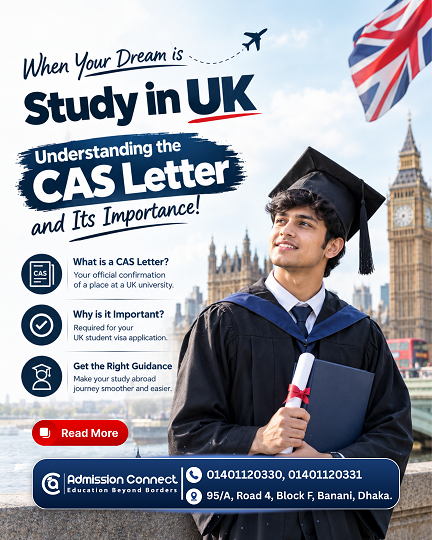
1. What Is a CAS Letter?
CAS stands for Confirmation of Acceptance for Studies. It is an electronic record assigned by a UK university or another institution authorised to sponsor international students under the Student route.
Although many students refer to it as a “CAS letter,” the CAS is technically a unique reference number linked to an electronic record held within the UK sponsorship system.
Your CAS confirms that an authorised education provider is sponsoring your proposed course of study. You must provide the CAS reference number as part of your UK Student Visa application.
A CAS record may contain important information such as:
- Your name and personal details
- Your university or education provider
- Your course title and qualification level
- Your course start and end dates
- Your tuition fees
- Tuition fees already paid, where applicable
- Relevant information about your qualifications and English-language assessment
You should carefully check the information supplied by your university and contact its CAS team if you notice any errors.
Important: A CAS is not a visa approval. UKVI makes the final decision on your Student Visa application.
2. What Is the Difference Between an Offer Letter and a CAS?
An offer letter and a CAS serve different purposes. Receiving one does not automatically mean you have received the other.
University Offer Letter
An offer letter confirms that a university has offered you a place on a course. Depending on your academic background and the institution's requirements, the offer may be conditional or unconditional.
A conditional offer means you must satisfy specified requirements before the university can confirm your place. These conditions may relate to academic qualifications, English-language proficiency or other outstanding documents.
Confirmation of Acceptance for Studies (CAS)
A CAS is the sponsorship record required for your UK Student Visa application. The university normally issues it after you have met the relevant requirements and completed its CAS procedures.
|
Offer Letter |
CAS |
|
Confirms an offer of admission |
Confirms Student route sponsorship |
|
May be conditional or unconditional |
Issued after the provider's applicable checks |
|
Helps you understand your admission status |
Provides the reference needed for your visa application |
|
Cannot replace a CAS |
Does not guarantee visa approval |
Remember: You cannot apply for a UK Student Visa using only your university offer letter. You need a valid CAS and must meet the other applicable visa requirements.
3. Why Is a CAS Important for Your UK Student Visa?
A CAS plays several important roles in the application process.
A. It Links Your Admission to Your Visa Application
The CAS identifies your sponsoring institution and proposed course. UKVI uses this information when assessing whether you meet the Student route requirements.
B. It Helps Establish Your Course and Sponsorship Details
The CAS contains relevant information about your programme, tuition fees and the qualifications or documents assessed by your sponsor. UKVI considers this information alongside the rest of your application.
C. It Helps You Prepare Your Financial Evidence
The tuition fee information recorded on your CAS can help you determine the course fees you may need to demonstrate for your visa application.
You must also consider the applicable maintenance funds, evidence requirements and any relevant exemptions. The amount required depends on your circumstances and where you will study.
For the latest financial rules, consult the official UK Student Visa financial requirements.
D. It Is a Required Part of the Application
You must provide a valid CAS reference number when applying for a UK Student Visa. An invalid, withdrawn or cancelled CAS can cause serious problems for an application.
4. When Can You Receive Your CAS?
There is no single timeline that applies to every student or university. The process depends on the institution, your course, your admission conditions and any additional checks required.
In many cases, the process involves the following stages.
Step 1: Receive Your University Offer
First, apply to a suitable UK university and receive an offer for your chosen course.
Review the offer carefully to understand the academic, English-language and documentary requirements.
Step 2: Meet Your Offer Conditions
If your offer is conditional, you must satisfy the relevant conditions before progressing to the next stage.
Depending on your circumstances, this may involve submitting final academic transcripts, certificates, English-language evidence or other requested documents.
Step 3: Accept Your Offer
Follow the university's instructions to formally accept your place. You may need to complete an acceptance form or confirm your decision through the university's online portal.
Step 4: Complete the University's CAS Procedures
Your university may ask you to complete additional steps before assigning your CAS. These can include:
- Submitting passport and academic documents
- Completing a pre-CAS questionnaire
- Attending a credibility interview, if required
- Paying a specified tuition fee deposit, where applicable
- Confirming your course details and financial arrangements
These procedures vary between institutions. Always follow the instructions provided by your university rather than assuming every university has the same process.
Step 5: Receive Your CAS Reference
Once the university has completed its required checks and determines that you are eligible for sponsorship, it may assign your CAS and provide you with the relevant details.
Review those details carefully before proceeding with your visa application.
5. How Long Does It Take to Get a CAS?
CAS processing times vary by university, intake, course and applicant circumstances.
Some universities can process a CAS relatively quickly once all requirements have been met. Others may need additional time to verify documents, review payments or complete credibility checks.
Factors that may affect the timeline include:
- Outstanding admission conditions
- Missing or inconsistent documents
- Delays in tuition fee payments
- University-specific pre-CAS interviews
- High application volumes during busy intakes
- Additional checks required by the sponsoring institution
To minimise avoidable delays, submit complete and accurate documents, monitor your university email regularly and respond promptly to requests from the admissions or CAS team.
If you are concerned about your timeline, contact the university directly for an update.
6. How Early Can You Apply for a UK Student Visa After Receiving Your CAS?
The timing of your visa application is important.
For applicants applying from outside the UK, the earliest you can generally apply for a Student Visa is six months before the course start date.
For eligible applicants applying from inside the UK, the earliest application date is generally three months before the course starts, subject to the applicable rules.
A CAS is generally valid for six months from the date it is assigned. It must also meet the validity requirements when you submit your application.
These are two separate timing rules: one concerns when you can apply for a visa, while the other concerns the validity of your CAS.
Check the latest official UK Student Visa guidance and your university's instructions before making your application.
7. What Documents May You Need Before CAS Issuance?
Your university will tell you which documents it requires. Depending on the institution and your circumstances, these may include:
- A valid passport
- Academic certificates and transcripts
- English-language test results or other accepted evidence
- Your university offer and acceptance confirmation
- Evidence that you have met the offer conditions
- Tuition fee deposit payment confirmation, if required
- Financial or sponsorship information, where requested
- Additional documents requested during pre-CAS checks
Keep your documents clear, consistent and up to date. Your name, date of birth and other personal information should match your passport and relevant supporting records.
Do not assume that every document requested by a university must automatically be submitted to UKVI. The documents required for the CAS process and those required for the visa application can differ.
8. What Should You Check on Your CAS Before Applying?
Once you receive your CAS details, review them thoroughly.
Personal Information
Check that your name and other identifying information are correct and consistent with your passport.
Course Information
Confirm the university name, course title, qualification level and course dates.
Tuition Fees and Payments
Check the tuition fee amount and any payments already recorded. If you have paid a deposit but it is not reflected correctly, contact your university before submitting your application.
English-Language Assessment
Review the relevant information about how your English-language ability was assessed, where applicable. Make sure you understand any additional evidence you may need to provide.
CAS Reference and Validity
Ensure that you have the correct CAS reference number and that the CAS meets the relevant validity requirements at the time of application.
If you find an error, contact your university's CAS team before submitting your visa application. Do not assume that an incorrect detail will be corrected automatically.
9. Understanding the UK Student Visa Financial Requirements
Receiving a CAS does not remove the financial requirements for a Student Visa.
Depending on your circumstances, you may need to demonstrate that you have sufficient funds to cover:
- Outstanding tuition fees for the relevant academic period
- Living costs at the applicable rate
- Additional costs required under the rules, where relevant
The amount of money required and the evidence you must provide depend on the current immigration rules and your individual circumstances.
For example, financial evidence may need to demonstrate that the required funds were held for a specified consecutive period. There are also particular rules about acceptable accounts, financial sponsorship and the timing of documents.
Some applicants may qualify for exemptions from submitting financial evidence upfront, but this does not necessarily mean they are exempt from meeting the financial requirement itself.
Always review the current UK Government financial evidence guidance before applying.
10. Common CAS Mistakes That Students Should Avoid
A well-organised application starts with understanding the process and following your university's instructions.
Avoid these common mistakes:
Mistake 1: Assuming an offer letter is enough
An offer letter and a CAS serve different purposes. Make sure you receive a valid CAS before applying for your Student Visa.
Mistake 2: Delaying the submission of documents
Missing academic records, passport details or other required documents can delay your university's CAS process.
Mistake 3: Ignoring pre-CAS requirements
Some universities require interviews, questionnaires, deposit payments or additional verification. Failing to complete these steps may delay sponsorship.
Mistake 4: Overlooking errors in your CAS
Incorrect personal details, course information or payment records should be raised with the university before you apply.
Mistake 5: Preparing financial evidence too late
Check the current financial requirements early enough to arrange the appropriate funds and evidence.
Mistake 6: Assuming CAS means visa approval
A CAS is an essential part of the process, but UKVI assesses your complete application. Meeting all applicable requirements remains your responsibility.
11. What Happens After You Receive Your CAS?
After receiving your CAS, you can prepare and submit your Student Visa application when you are eligible to apply.
Your next steps generally include:
- Reviewing your CAS details.
- Checking the latest Student Visa requirements.
- Preparing the required supporting documents.
- Completing the online visa application.
- Paying the applicable visa application fee and Immigration Health Surcharge, where required.
- Following the current instructions for identity verification or biometric enrolment.
- Waiting for a decision from the relevant UK authorities.
Additional requirements may apply depending on your nationality, course and personal circumstances.
Keep copies of your application records and follow official instructions throughout the process.
12. Planning to Study in the UK? Get the Right Guidance
Your CAS is an important milestone, but a successful study abroad plan begins much earlier.
Choosing a suitable university, understanding course requirements, preparing accurate documents and meeting the relevant admission conditions can help you approach the process in an organised way.
Admission Connect supports students in exploring UK study options and understanding the steps involved in the application journey.
Our services include:
- University and course selection guidance
- Personalised profile assessment and counselling
- Admission application support
- Academic document guidance
- Assistance in understanding university-specific CAS procedures
- Guidance on preparing for the Student Visa application
We aim to help you make informed decisions and understand each stage of your application. Final admission decisions and CAS issuance remain with the relevant university, while visa decisions are made by UKVI.
Start Your UK Study Journey with Admission Connect
Are you planning to study in the UK and want to understand your next steps?
Contact our team to explore your options and receive guidance based on your academic profile and goals.
Admission Connect
Education Beyond Borders
Hotline: 01401-120330 | 01401-120331
Office Address:
House 95/A (Flat 3A), Road 4, Block F, Banani, Dhaka-1213.
Frequently Asked Questions About the UK CAS Letter
1. Can I apply for a UK Student Visa with an offer letter only?
No. You need a valid CAS reference number from a licensed Student sponsor, along with the other required information and evidence.
2. Is a CAS the same as a university offer letter?
No. An offer letter confirms an offer of admission. A CAS is an electronic sponsorship record used for the Student Visa application.
3. Does receiving a CAS guarantee a UK Student Visa?
No. UKVI assesses the complete application against the relevant immigration requirements. A CAS does not guarantee approval.
4. Do all universities require a CAS deposit?
No. Deposit policies differ by institution and course. Some universities require a payment before issuing a CAS, while the amount and timing depend on their policies and your circumstances.
5. Do all students need a pre-CAS interview?
No. Pre-CAS interviews and other credibility checks depend on the university's procedures and individual circumstances.
6. How long is a CAS valid?
A CAS is generally valid for six months from the date it is assigned, subject to the applicable rules. Check that it is valid when you submit your visa application.
7. Can I apply for a visa immediately after receiving my CAS?
You can apply once you meet the relevant application requirements and are within the permitted application window. Applicants applying from outside the UK can generally apply up to six months before the course starts.
8. What should I do if my CAS contains incorrect information?
Contact your university's CAS team promptly and ask them to review and correct the details before you submit your visa application.
Final Thoughts
Understanding the CAS process can help you plan your UK study journey with greater clarity. From meeting your university's offer conditions to checking your CAS details and preparing financial evidence, each stage deserves careful attention.
Start early, follow your university's instructions and always check the latest official UK immigration guidance before applying.
Your UK study journey starts with the right information, careful preparation and a well-planned application.
Official Sources and Further Reading